
A buggy launch can permanently damage a game’s reputation and destroy player trust before it has a chance to grow. In today’s competitive market, there’s no room for broken mechanics, crashes, or overlooked glitches. That’s where professional game testing and quality assurance come in. These services act as your final safeguard, ensuring your title is polished, stable, and ready for players on day one. In this guide, you’ll learn what modern QA services include, why they’re essential to successful development, and how to choose the right testing partner to help you ship with confidence.
Beyond Bug Hunts: The True Scope of Modern Game QA
Understanding the meticulous processes behind game testing and quality assurance can shed light on the challenges developers face, especially with anticipated launches like those covered in our article on the release dates of new consoles at Lcftechmods – for more details, check out our Release Date New Consoles Lcftechmods.
For years, QA was shorthand for “find the bugs.” Crashes? Log it. Glitchy textures? Screenshot it. But that narrow view misses the bigger picture. Modern QA validates the entire player journey—from first boot to end credits (and yes, even the rage-quit moments).
Redefining QA means treating the player experience as the product—not just the code. While competitors focus on surface-level defect counts, elite teams map emotional friction points, onboarding confusion, and performance dips that erode trust over time.
Core Pillars of Game Testing
Functionality Testing ensures mechanics, quests, AI behavior, and progression systems work as intended. A single broken checkpoint can undo hours of goodwill—just ask anyone who lost a save file before a boss fight.
Compatibility Testing runs games across complex hardware matrices: high-end GPUs, budget PCs, PS5, Xbox Series X/S, Switch, iOS, and Android devices. According to Valve’s Steam Hardware Survey, player PC configurations vary dramatically, making broad optimization essential.
Performance Testing measures framerates, load times, and memory usage. Studies show players notice framerate drops below 60 FPS in fast-paced titles (NVIDIA developer insights), directly impacting retention.
UX & Usability Testing evaluates clarity of tutorials, menu logic, and accessibility features. If players can’t understand your crafting system, they won’t engage with it—no matter how innovative it is.
Some argue automated tools can replace deep review. They help, but true game testing and quality assurance requires human context. Especially when evaluating systems tied to monetization models in modern gaming explained, where balance affects fairness perception.
Pro tip: Track player frustration metrics alongside bug counts. That’s the competitive edge most studios still overlook.
The Strategic Advantage of Outsourcing Your Game Testing
Studios love to talk about innovation, but here’s my take: innovation dies when your best developers are stuck replaying the same level for the fiftieth time hunting edge-case bugs. That’s not creativity—that’s burnout with better lighting. Outsourcing testing frees your internal team to focus on building bold mechanics, richer worlds, and smarter systems instead of grinding through repetitive QA loops.
Some argue testing should always stay in-house because “no one understands the game better than the devs.” Fair point. But that’s also the problem. Familiarity breeds blind spots. Developers develop what I call dev eyes—you know every shortcut, every intended path, every “that’s good enough.” Fresh testers don’t. They jump where they shouldn’t, break what you thought was unbreakable, and question design choices without emotional attachment. That outside perspective is invaluable.
Then there’s hardware. Professional QA partners maintain labs packed with hundreds of device configurations—PC builds, consoles, mobile variants. Replicating that setup internally is wildly expensive (and let’s be honest, your budget would rather fund a new feature). Access to that arsenal means broader compatibility coverage without the capital drain.
Scalability is another underrated advantage. Launch windows are chaos. You need volume, fast. After release? Not so much. Outsourcing lets you ramp up during critical milestones and scale down later, paying only for what you use.
- Faster iteration cycles
- Broader device coverage
- Objective player feedback
In my opinion, smart studios treat game testing and quality assurance as a strategic partnership, not a side task. Keep your creative engine focused on building magic—and let specialists handle breaking it first.
The QA Services Checklist: Must-Haves for Your Testing Partner
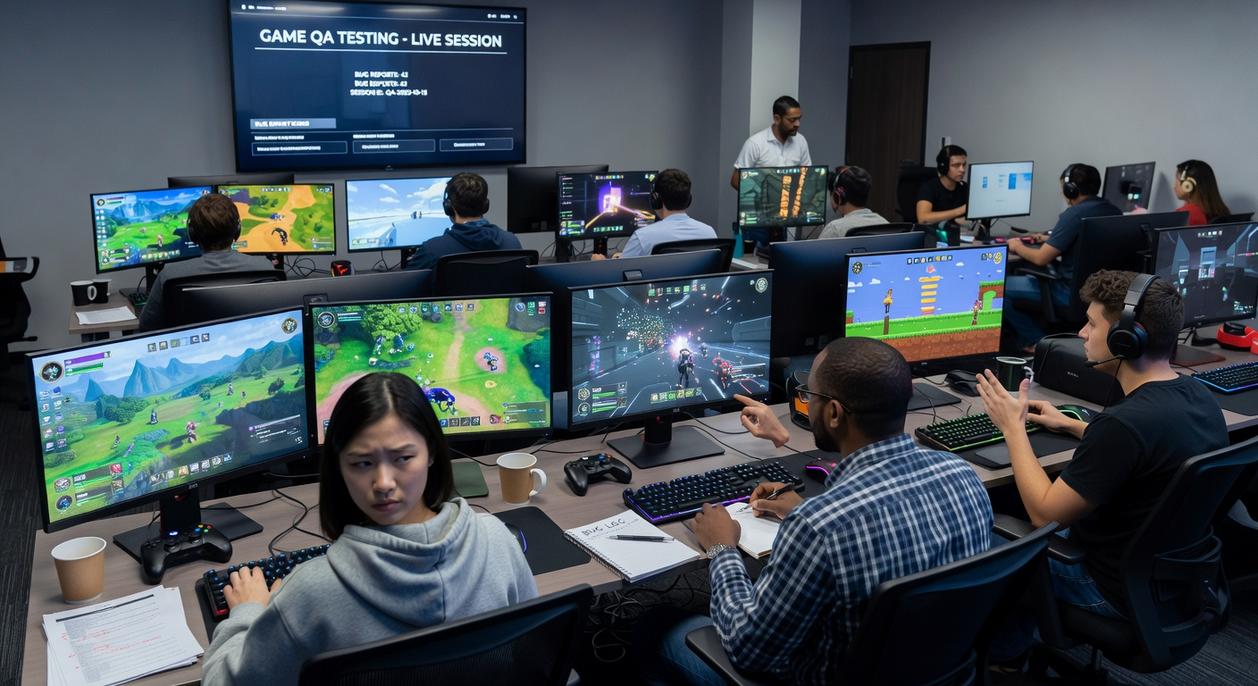
Choosing a QA partner can feel like decoding patch notes without context. So let’s break down what actually matters.
Functionality & Regression Testing
This is the foundation. Functionality testing means verifying that every feature works as intended—menus open, saves load, multiplayer connects. Regression testing ensures that when developers fix or add something, they don’t accidentally break something else (yes, that happens more than studios like to admit). Think of it like fixing a leaky pipe and suddenly the shower stops working. A systematic, repeatable process here is non-negotiable.
Compliance & Certification Testing
Platform holders like Sony, Microsoft, and Nintendo have strict technical requirement checklists. Certification testing ensures your build meets those standards before submission. Without it, you risk rejection, delays, and extra costs. Some argue small studios can “figure it out” themselves—but failed submissions can set timelines back weeks. That’s a gamble most teams can’t afford.
Localization QA
This goes beyond translation. It checks cultural appropriateness, text overflow in UI, subtitle timing, and whether dialogue makes sense in context. (Remember the meme-worthy mistranslations in early JRPGs?) A seamless global launch depends on this layer of polish.
Live-Ops & Post-Launch Support
Launch isn’t the finish line. Ongoing QA for patches, DLC, and live events keeps player trust intact. Live-ops refers to the continuous updates and in-game events that keep a title active long term.
Detailed Bug Reporting
Clear reports with screenshots, video captures, replication steps, and direct integration into tools like Jira or Asana save developers hours. Vague reports waste time; actionable ones accelerate fixes.
At its core, game testing and quality assurance is about risk reduction. The right partner doesn’t just find bugs—they protect your launch, reputation, and long-term player loyalty.
Secure Your Launch and Protect Your Player Experience
A game’s launch is its single most important moment—and technical issues are the fastest way to derail it. You set out to learn how to protect your player experience, and now you understand that proactive game testing and quality assurance are what separate breakout successes from frustrating flops.
Partnering with a dedicated QA service isn’t an expense—it’s an investment in smoother launches, stronger reviews, and long-term studio growth. Don’t risk negative feedback and lost players. Use the checklist from this guide to vet a trusted QA partner today and give your game the polished debut it deserves.

 Linda Boggandaron writes the kind of insider explorations content that people actually send to each other. Not because it's flashy or controversial, but because it's the sort of thing where you read it and immediately think of three people who need to see it. Linda has a talent for identifying the questions that a lot of people have but haven't quite figured out how to articulate yet — and then answering them properly.
They covers a lot of ground: Insider Explorations, Esports Team Developments, Game Hosting and Setup Tips, and plenty of adjacent territory that doesn't always get treated with the same seriousness. The consistency across all of it is a certain kind of respect for the reader. Linda doesn't assume people are stupid, and they doesn't assume they know everything either. They writes for someone who is genuinely trying to figure something out — because that's usually who's actually reading. That assumption shapes everything from how they structures an explanation to how much background they includes before getting to the point.
Beyond the practical stuff, there's something in Linda's writing that reflects a real investment in the subject — not performed enthusiasm, but the kind of sustained interest that produces insight over time. They has been paying attention to insider explorations long enough that they notices things a more casual observer would miss. That depth shows up in the work in ways that are hard to fake.
Linda Boggandaron writes the kind of insider explorations content that people actually send to each other. Not because it's flashy or controversial, but because it's the sort of thing where you read it and immediately think of three people who need to see it. Linda has a talent for identifying the questions that a lot of people have but haven't quite figured out how to articulate yet — and then answering them properly.
They covers a lot of ground: Insider Explorations, Esports Team Developments, Game Hosting and Setup Tips, and plenty of adjacent territory that doesn't always get treated with the same seriousness. The consistency across all of it is a certain kind of respect for the reader. Linda doesn't assume people are stupid, and they doesn't assume they know everything either. They writes for someone who is genuinely trying to figure something out — because that's usually who's actually reading. That assumption shapes everything from how they structures an explanation to how much background they includes before getting to the point.
Beyond the practical stuff, there's something in Linda's writing that reflects a real investment in the subject — not performed enthusiasm, but the kind of sustained interest that produces insight over time. They has been paying attention to insider explorations long enough that they notices things a more casual observer would miss. That depth shows up in the work in ways that are hard to fake.