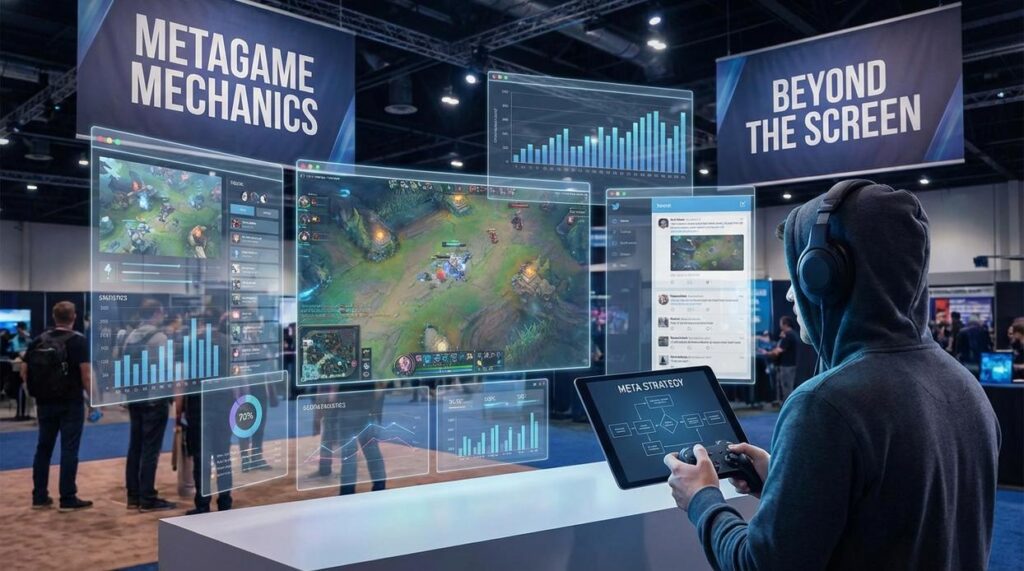

Great aim might win duels, but it won’t consistently win matches. If you’re constantly getting picked from off-angles, losing control of objectives, or feeling outmaneuvered despite solid mechanics, your positioning—not your crosshair—is the real issue. This guide focuses on team-based shooter positioning tactics that separate average players from match-carrying teammates. Built on deep analysis of thousands of hours of pro-level competitive play and core FPS theory, it breaks down how to hold smarter angles, use cover with intent, and move in sync with your team. By the end, you’ll understand how to turn map presence into a consistent, decisive advantage.
The Geometry of a Gunfight: Angles, Cover, and Peeker’s Advantage
Mastering advanced positioning tactics can drastically enhance your performance in team-based shooters, much like the meticulous planning and coordination seen in the development of AAA games, which we explore in our article “A Behind-the-Scenes Look at How AAA Games Are Developed.
Back in 2019, when tactical shooters surged on Twitch, players started obsessing over one concept: angle advantage. Simply put, angle advantage means positioning so you see an opponent before they see you, by exposing the smallest possible part of your character model. Because of camera perspective and latency (often measured in milliseconds), the player moving into an angle frequently appears first on their own screen—a phenomenon called peeker’s advantage. According to Riot Games’ developer notes on netcode, even low ping differences can influence who appears first in tight duels (Riot Dev Blog, 2020).
However, some argue that raw aim matters more than geometry. And yes, cracked mechanics can bail you out. But over hundreds of rounds, positioning wins more fights than flick speed (think less John Wick, more chess grandmaster).
Then there are off-angles—unexpected positions slightly away from common sightlines. Because most players pre-aim “default” spots, holding an off-angle disrupts crosshair placement. After weeks of scrim testing, teams consistently reported higher opening duel success from subtle off-angle adjustments.
Next, understand hard cover versus soft cover. Hard cover (solid walls) stops bullets entirely. Soft cover (wooden boxes, thin doors) can be wall-banged depending on weapon penetration stats (Valve patch notes, 2021). Plan your escape route before you swing—don’t improvise mid-spray.
Finally, distinguish a jiggle peek from a wide swing. A jiggle peek is a quick shoulder movement for information gathering; a wide swing commits to the fight, leveraging peeker’s advantage. Use team-based shooter positioning tactics in the section once exactly as it is given. Pro tip: jiggle early in rounds, swing when you have intel and timing on your side.
Winning the Vertical Battle: The High Ground Imperative

Securing high ground means positioning your character above the enemy to gain a clearer view and control of the fight. In simple terms, height gives you better information and forces opponents into a vertical aim duel—where they must flick their crosshair upward while you aim slightly downward (which is mechanically easier for most players).
The Headshot Multiplier Explained
In many shooters, a headshot multiplier increases damage when you hit the head instead of the body. From above, your character model naturally hides more of your head while exposing an enemy’s full head and shoulders. That geometry matters. You see more of them; they see less of you. It’s not magic—it’s angles.
Use team-based shooter positioning tactics in the section once exactly as it is given
Some argue high ground is overrated because skilled aim wins fights anyway. Fair point. But even elite players prefer stacked odds. Height is a statistical advantage, not a guarantee.
Countering High Ground
- Throw smokes to block sightlines
- Use flashes to force defenders off angles
- Double-peek to split attention
When Low Ground Works
Ambush spots under staircases or drop-down ledges can flip expectations (surprise beats ego). Low ground succeeds when timing, not visibility, does the heavy lifting.
Playing as a Unit: Crossfires, Trades, and Map Control
Great teams don’t win fair fights. They engineer unfair ones. A crossfire—two players holding different angles on the same chokepoint—creates overlapping lines of sight that force an enemy to expose themselves to at least one shooter. In practical terms, if one teammate anchors close left while another holds a deeper off-angle, the attacker can’t clear both without turning their back (and that’s usually game over). Some argue stacking one angle is safer. But doubling a single sightline invites utility dumps and pre-fires. A layered crossfire denies that predictability.
Then there’s the trade—the immediate re-frag after your teammate falls. A re-frag means eliminating the opponent before they can reposition, heal, or reload. Statistically, coordinated trading dramatically improves round conversion rates in pro play (see HLTV event breakdowns, 2024). Critics say trading is just “damage control.” Not quite. It prevents a 5v4 snowball and keeps map pressure stable.
Map control isn’t camping one corner. It’s a network of positions that blocks rotations, sightlines, and resource access. Think of it like zoning in basketball—space denied is opportunity removed. Effective team-based shooter positioning tactics prioritize chokepoints, flanks, and information routes over flashy kills.
Information wins rounds. Position one player as visible “bait” while a teammate holds the punish angle (yes, it feels like a spy movie). When done right, the enemy overcommits. For deeper strategic frameworks, review how to build a winning strategy in real time strategy games—the principles translate surprisingly well.
Pro tip: If you can’t explain your position’s purpose in one sentence, you probably shouldn’t be there.
Reading the Mid-Round Like a Pro
Have you ever wondered why a position that felt perfect 20 seconds ago suddenly turns into a trap? Mid-round adaptation is the difference between clutching and spectating. First and foremost, your minimap is more than decoration—it’s a real-time information hub showing teammate positions and revealed enemies. Pair that with audio cues—footsteps, reloads, utility usage—and you can sense when your current angle is no longer viable. Sound familiar?
Once you recognize danger, effective rotations become critical. So, do you slow things down with a quiet lurk—moving carefully to catch rotating enemies—or commit to a fast, decisive group rotation that overwhelms a weak site? The choice depends on timing, numbers, and map control (hesitation usually means trouble).
On defense, however, sometimes the smartest move is to give up space. Playing for retakes means staying alive, regrouping, and using coordinated team-based shooter positioning tactics to reclaim the objective together. After all, a 5v5 retake beats a desperate 1v3 hero play.
Finally, consider post-plant scenarios. Are you setting up a crossfire on the planted objective, or are you peeking alone? Smart spacing, layered angles, and patience usually guarantee the round once the spike is down.
From Conscious Action to Winning Instinct
You came here to sharpen your edge, and now you have a complete toolkit for thinking strategically in every phase of the match. No more getting eliminated and wondering from where. The real shift happens when you stop reacting and start controlling engagements—dictating angles, owning verticality, and syncing with teammates to apply smart team-based shooter positioning tactics.
This is how you turn chaos into control.
In your very next match, focus on one concept. Set up a deliberate crossfire or secure high ground and hold it with purpose. Practice until it becomes instinct.
If you’re serious about winning more fights and climbing faster, start applying these tactics now and make every engagement count.

 There is a specific skill involved in explaining something clearly — one that is completely separate from actually knowing the subject. Zelric Droshar has both. They has spent years working with esports team developments in a hands-on capacity, and an equal amount of time figuring out how to translate that experience into writing that people with different backgrounds can actually absorb and use.
Zelric tends to approach complex subjects — Esports Team Developments, Hot Topics in Gaming, Game Hosting and Setup Tips being good examples — by starting with what the reader already knows, then building outward from there rather than dropping them in the deep end. It sounds like a small thing. In practice it makes a significant difference in whether someone finishes the article or abandons it halfway through. They is also good at knowing when to stop — a surprisingly underrated skill. Some writers bury useful information under so many caveats and qualifications that the point disappears. Zelric knows where the point is and gets there without too many detours.
The practical effect of all this is that people who read Zelric's work tend to come away actually capable of doing something with it. Not just vaguely informed — actually capable. For a writer working in esports team developments, that is probably the best possible outcome, and it's the standard Zelric holds they's own work to.
There is a specific skill involved in explaining something clearly — one that is completely separate from actually knowing the subject. Zelric Droshar has both. They has spent years working with esports team developments in a hands-on capacity, and an equal amount of time figuring out how to translate that experience into writing that people with different backgrounds can actually absorb and use.
Zelric tends to approach complex subjects — Esports Team Developments, Hot Topics in Gaming, Game Hosting and Setup Tips being good examples — by starting with what the reader already knows, then building outward from there rather than dropping them in the deep end. It sounds like a small thing. In practice it makes a significant difference in whether someone finishes the article or abandons it halfway through. They is also good at knowing when to stop — a surprisingly underrated skill. Some writers bury useful information under so many caveats and qualifications that the point disappears. Zelric knows where the point is and gets there without too many detours.
The practical effect of all this is that people who read Zelric's work tend to come away actually capable of doing something with it. Not just vaguely informed — actually capable. For a writer working in esports team developments, that is probably the best possible outcome, and it's the standard Zelric holds they's own work to.