
If you’re looking to build, improve, or better understand an esports organization, you’re likely searching for clarity on how successful teams actually operate behind the scenes. Competitive gaming is no longer just about raw talent—it’s about structure, coordination, and smart leadership. This article breaks down the essentials of esports team management structure, explaining how roles are defined, how communication flows, and how top teams create systems that consistently deliver results.
Many aspiring managers and players struggle with disorganized leadership, unclear responsibilities, and inefficient practice setups. Here, you’ll find a clear framework for organizing coaching staff, analysts, team captains, and operational leads so performance and morale both improve.
Our insights are informed by in-depth analysis of professional team models, tournament standards, and proven competitive strategies used across major esports titles. By the end, you’ll have a practical understanding of how to structure and manage a team built for long-term success.
Raw talent wins matches; structure wins seasons. To build a sustainable contender, start by defining roles beyond players: head coach, analyst, performance psychologist, and operations lead. This esports team management structure prevents confusion and burnout.
Next, implement:
- A fixed practice schedule with review blocks
- Clear conflict-resolution protocols
- Mandatory rest days and fitness check-ins
For example, top organizations like T1 attribute longevity to disciplined systems (Forbes, 2023).
Finally, track goals quarterly, not emotionally. Talent feels exciting, but process delivers trophies (think Moneyball, not ranked solo queue). Document standards and review performance metrics weekly to sustain accountability. Consistency compounds into championships. Eventually.
The Foundational Roster: Defining Roles In and Out of the Game
Clarity wins championships. In Counter-Strike alone, teams with stable in-game roles maintained higher long-term win rates across Majors compared to rosters with frequent role swaps (HLTV performance trend data, 2018–2023). That’s not coincidence—it’s structure.
In-game roles are specialized responsibilities within a match. An IGL (In-Game Leader) calls strategy mid-round. An AWPer wields the high-impact sniper rifle. The Entry creates space by taking first contact. The Support enables others with utility. The Lurker pressures flanks and gathers information. When these roles blur, hesitation creeps in (and hesitation loses rounds).
However, roles shouldn’t be assigned by preference alone. Research in sports psychology shows athletes perform better when roles align with personality traits like decisiveness or patience (Journal of Applied Sport Psychology, 2020). For example, assertive communicators thrive as IGLs, while detail-oriented players often excel in Support.
| Role | Core Trait | Primary Value |
|---|---|---|
| IGL | Decisive |
Strategic cohesion |
| Entry | Fearless | Map control |
| Support | Selfless | Resource optimization |
Meanwhile, the essential support staff carry invisible weight. A Head Coach shapes long-term systems. A Strategic Analyst studies opponents and data trends. A Team Manager handles logistics and discipline. Together, they form the backbone of an effective esports team management structure, offloading cognitive strain so players focus purely on performance.
Importantly, the Captain differs from the IGL. The IGL leads tactics in-game; the Captain safeguards culture, morale, and accountability off-server (think Aragorn versus Gandalf—different leadership lanes).
During recruitment, prioritize cultural fit. Ask: How do you handle feedback? What does productive practice look like? Teams that value alignment over meta-chasing show greater roster longevity (Esports Insider, 2022). Pro tip: talent wins games; cohesion wins eras.
The Engine Room: Architecting a Professional Practice Regimen
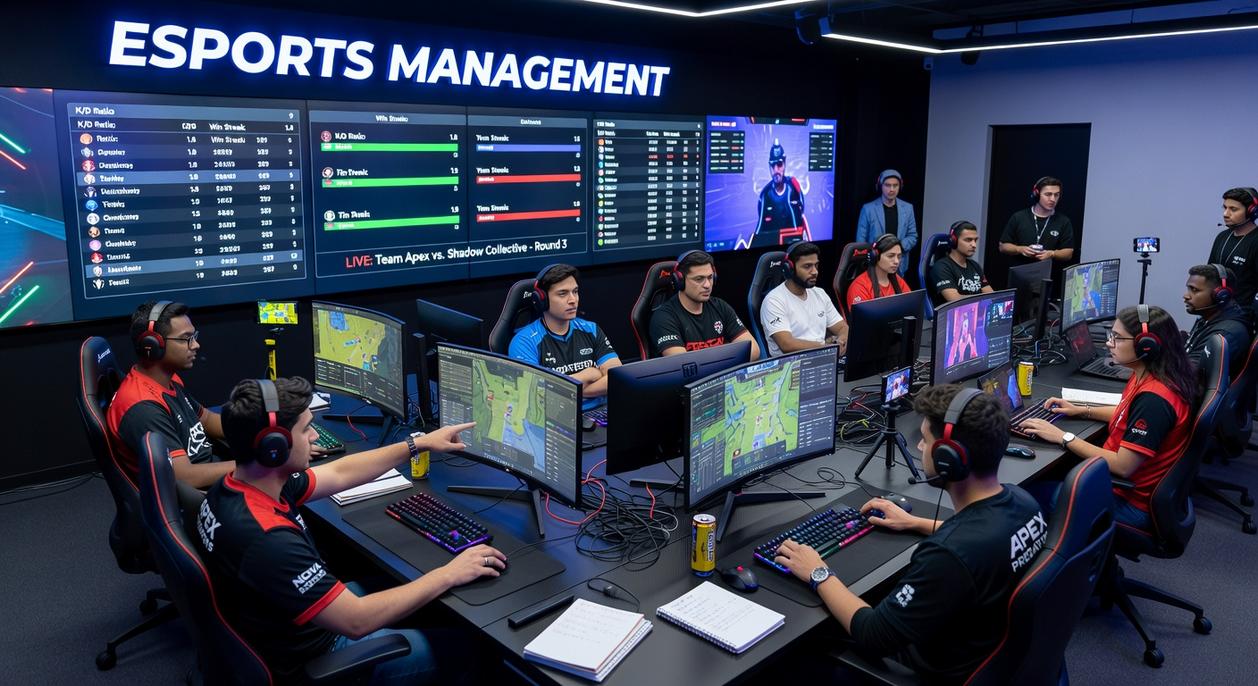
I learned this the hard way.
Early in my competitive career, we scrimmed endlessly—six, sometimes eight hours a day. We thought volume equaled progress. It didn’t. We were busy, not better. (There’s a difference.) That shift—from grinding to structuring—changed everything.
Moving beyond endless scrims means designing a repeatable system. Scrims (organized practice matches against other teams) are valuable, but without structure, they reinforce bad habits. Research in deliberate practice shows focused, feedback-driven training outperforms mindless repetition (Ericsson et al., 1993).
A simple weekly template:
- Monday: VOD review + goal setting
- Tuesday: Individual mechanics block + short scrims
- Wednesday: Team scrims (scenario-focused)
- Thursday: Theory crafting + anti-strat prep
- Friday: Full scrim day (tournament simulation)
- Saturday: Targeted drills + communication review
- Sunday: Break day
Making VOD reviews productive, not toxic requires a framework. Focus on systems, not scapegoats. Instead of “You misplayed,” say, “Our spacing during executes collapsed.” Define systemic issues (repeatable team-wide breakdowns) and attach solutions. Over time, this builds trust—players critique problems, not people.
Theory and strategy sessions are your differentiator. Block off-device time to map executes, develop counter-strats, and predict meta shifts (the evolving dominant strategies in a game). Amateur teams skip this. Pros treat it like a chess lab.
Measuring progress means tracking more than wins. Monitor objective completion rate, successful execute percentage, and communication efficiency (clear callouts per round). Pro tip: review one metric weekly, not all at once.
Structure feels rigid at first. But freedom in competition comes from discipline in practice.
Sustaining Peak Performance: Player Health and Burnout Prevention
Peak performance isn’t just mechanics and strategy—it’s biology. Studies from the National Sleep Foundation show reaction time can drop by up to 25% with sleep deprivation, directly impacting in-game decisions. Scheduled workouts improve blood flow and cognitive flexibility, while balanced nutrition stabilizes energy (no more mid-match crashes). In fact, research in Frontiers in Psychology links regular exercise to improved executive function—critical for shot-calling under pressure. Physical health is competitive advantage.
Mental health infrastructure matters just as much. A sports psychologist helps players manage performance anxiety and “tilt” (emotional frustration that sabotages focus). Techniques like controlled breathing and cognitive reframing have been shown to lower cortisol levels during high-stakes events. Teams integrating structured support into their esports team management structure report stronger consistency across tournaments.
Mandatory downtime isn’t laziness—it’s longevity. The World Health Organization recognizes burnout as an occupational phenomenon. Structured off-days preserve intrinsic motivation (remember why you loved the game in the first place).
- Schedule two rest days weekly.
- Rotate scrim intensity monthly.
- Conduct quarterly mental check-ins.
Finally, create a safe feedback environment. Clear communication rules reduce hostility and improve retention, as shown in organizational psychology studies. Many insights stem from analyzing training routines inside professional esports organizations, where constructive critique—not blame—drives sustainable success.
Establishing core values means defining a shared mission and code of conduct before scrims begin. With them, decisions feel consistent; without them, every loss becomes personal. Communication protocols matter just as much. Discord for daily strategy, team meetings for major issues keeps signals clear; random DMs create silos. Think esports team management structure: roles, reporting lines, accountability. For disputes, compare A versus B: public callouts escalate, mediated talks deescalate. A step by step review led by the manager or captain focuses on evidence, goals, and next actions. Pro tip: document outcomes to prevent repeat drama. Trust process over ego.
From chaos to cohesion, elite performance is not magic; it’s method. This guide proved that talent without structure collapses under pressure. However, many argue raw chemistry beats process. Yet even championship rosters rely on clear roles, disciplined practice, and recovery systems backed by sports psychology research (see APA, 2020). The real shift begins with an honest audit: is your weakness practice flow, role clarity, or burnout? Next, apply one upgrade to your esports team management structure this week. Pro tip: document scrims like analysts do. Small, consistent fixes compound into pro-level cohesion (think Avengers, but organized). Over time, sustainably, intentionally.
As we explore the evolution of esports team management structures, it’s fascinating to consider how these changes have influenced the organization of massive tournaments like Pblgamevent, which showcases the strategic planning behind successful hosted events – for more details, check out our Hosted Event Pblgamevent.
Build a Winning Roster That Lasts
You came here to understand how to create a stronger, more competitive esports organization—and now you have the blueprint. From defining clear roles to refining communication systems and optimizing your esports team management structure, you’ve seen how the right foundation directly impacts performance, morale, and long-term growth.
Disorganization, unclear leadership, and poor coordination are what hold most teams back. Talent alone isn’t enough. Without structure and strategy, even the most skilled roster will struggle to stay consistent in high-pressure tournaments.
Now it’s time to take action. Audit your current setup, refine leadership roles, and implement systems that support both players and coaching staff. If you’re serious about building a team that dominates brackets instead of collapsing under pressure, start applying these strategies today.
Thousands of competitive players and team managers rely on our in-depth guides to sharpen their edge. Don’t let weak management cost you your next championship run—level up your structure now and turn potential into podium finishes.

 There is a specific skill involved in explaining something clearly — one that is completely separate from actually knowing the subject. Zelric Droshar has both. They has spent years working with esports team developments in a hands-on capacity, and an equal amount of time figuring out how to translate that experience into writing that people with different backgrounds can actually absorb and use.
Zelric tends to approach complex subjects — Esports Team Developments, Hot Topics in Gaming, Game Hosting and Setup Tips being good examples — by starting with what the reader already knows, then building outward from there rather than dropping them in the deep end. It sounds like a small thing. In practice it makes a significant difference in whether someone finishes the article or abandons it halfway through. They is also good at knowing when to stop — a surprisingly underrated skill. Some writers bury useful information under so many caveats and qualifications that the point disappears. Zelric knows where the point is and gets there without too many detours.
The practical effect of all this is that people who read Zelric's work tend to come away actually capable of doing something with it. Not just vaguely informed — actually capable. For a writer working in esports team developments, that is probably the best possible outcome, and it's the standard Zelric holds they's own work to.
There is a specific skill involved in explaining something clearly — one that is completely separate from actually knowing the subject. Zelric Droshar has both. They has spent years working with esports team developments in a hands-on capacity, and an equal amount of time figuring out how to translate that experience into writing that people with different backgrounds can actually absorb and use.
Zelric tends to approach complex subjects — Esports Team Developments, Hot Topics in Gaming, Game Hosting and Setup Tips being good examples — by starting with what the reader already knows, then building outward from there rather than dropping them in the deep end. It sounds like a small thing. In practice it makes a significant difference in whether someone finishes the article or abandons it halfway through. They is also good at knowing when to stop — a surprisingly underrated skill. Some writers bury useful information under so many caveats and qualifications that the point disappears. Zelric knows where the point is and gets there without too many detours.
The practical effect of all this is that people who read Zelric's work tend to come away actually capable of doing something with it. Not just vaguely informed — actually capable. For a writer working in esports team developments, that is probably the best possible outcome, and it's the standard Zelric holds they's own work to.